
BEHIND-MS at ECTRIMS 2026
Can understanding EBV help us move towards MS prevention?
Posted on November 10, 2026 • 4 minutes • 769 words
Table of contents
BEHIND-MS at ECTRIMS 2026:
Can understanding EBV help us move towards MS prevention?
At ECTRIMS 2026, the session “Towards MS prevention” explored an increasingly important question: if we better understand what happens before multiple sclerosis develops, could we eventually intervene earlier, or even prevent it?
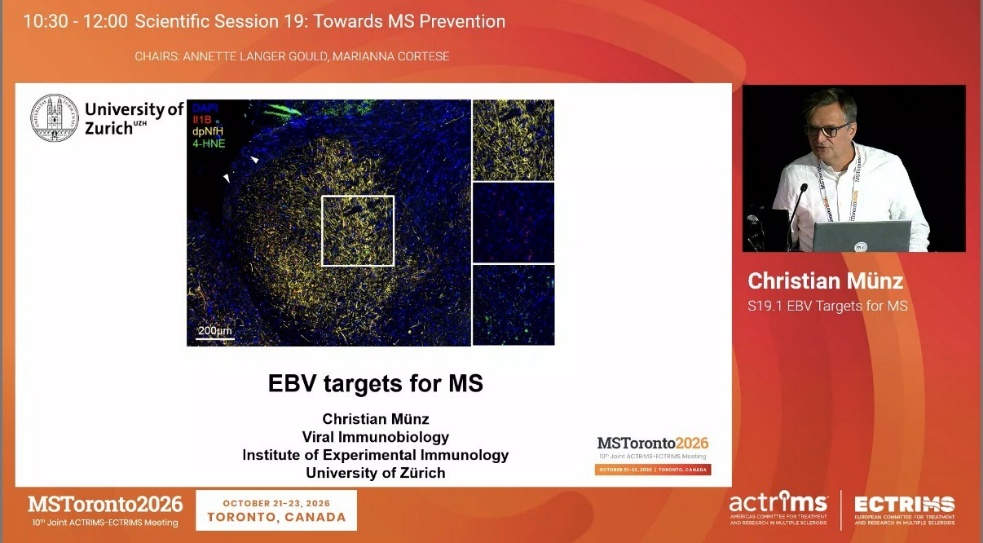
As part of the session, Prof. Christian Münz presented research from the BEHIND-MS project, providing new insights into how Epstein-Barr virus (EBV) could contribute to inflammation and damage in the central nervous system.
How could EBV contribute to MS?
Evidence increasingly points to EBV as an important factor in MS. Previous research discussed by Prof. Münz showed that EBV infection can occur years before the first clinical symptoms of MS, raising an important question: how could EBV trigger processes that eventually affect the brain and spinal cord?
Using a humanised mouse model carrying an important genetic risk factor for MS, BEHIND-MS researchers investigated what happens to immune cells following EBV infection.
The team identified a particular population of T-bet and CXCR3-positive B cells that expanded following EBV infection and were able to migrate into the central nervous system. These B cells could then attract other immune cells, including T cells.
In the experimental model, infiltration by activated CD4 T cells correlated with increased neurofilament light chain, a marker associated with neuronal damage.
The findings point towards a potential pathway:
EBV infection → specific B cells → migration into the central nervous system → recruitment of T cells → inflammation and tissue damage
B-cell depletion reduced the migration of both B and T cells into the central nervous system in the model, providing another clue as to where this process might potentially be interrupted.
New Insights into T Cells, EBV and the MS Brain
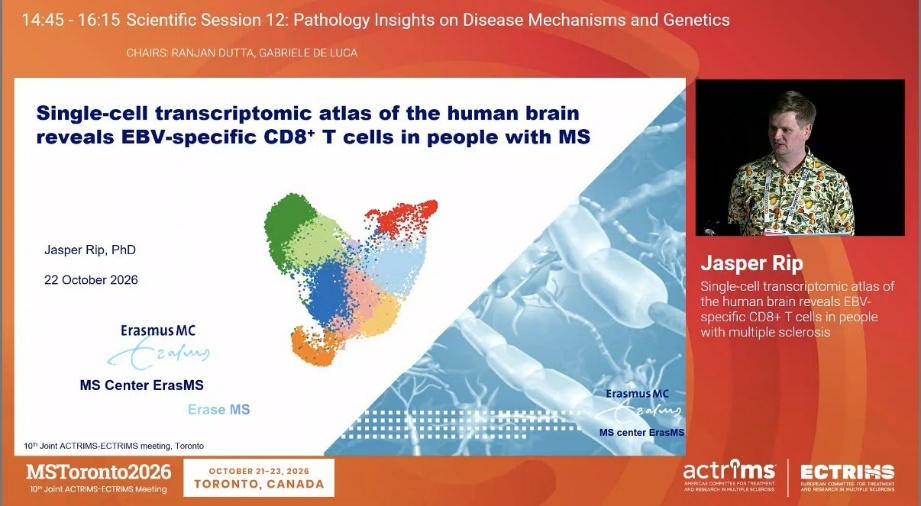
In his presentation, Jasper Rip shared research exploring how T cells behave in different parts of the central nervous system in MS. The findings suggest that the brain and CSF environment strongly shape T-cell behaviour, particularly in progressive MS. Researchers also identified EBV-reactive T cells among expanded T-cell populations in MS brain tissue, providing another piece of the puzzle in understanding the link between EBV and MS.
More BEHIND-MS research at ECTRIMS
BEHIND-MS was also represented through two poster presentations exploring the relationship between EBV, B cells and MS from different perspectives.
Prof. Roberta Magliozzi and colleagues presented “Multiomic landscape of latently EBV infected B cells infiltrating progressive MS brains.” The study examined post-mortem brain and spinal cord tissue from people with progressive MS and identified EBV-associated B cells in the examined MS cases, but not in neurological controls. The findings support a potential role for chronic EBV infection in sustaining abnormal B-cell expansion, maturation and activity within the central nervous system during MS progression.
Prof. Manuel Comabella and colleagues presented “Ocrelizumab Reduces EBV-Specific Antibody Levels and Effector Function in Multiple Sclerosis.” In a cohort of 265 people with MS, the researchers found that ocrelizumab treatment was associated with a sustained reduction in antibodies against EBNA1, an EBV antigen, as well as reduced EBV-specific antibody effector functions. The researchers suggest that the therapeutic benefit of ocrelizumab in MS may, at least in part, involve reducing EBV-driven antigenic immune stimulation.
Prof. Joost Smolders presented a poster providing further insights into how the immune system associates with Epstein-Barr virus (EBV) in people with MS. The study examined anti-EBV antibody levels alongside genetic risk to stratify people with a high- or low cumulative risk of MS after an optic neuritis and investigated associated changes in peripheral B- and T-cell populations. The findings suggest that studying people with optic neuritis who differ in their genetic risk for MS and immune response to EBV can reveal early differences in B and CD4+ T cells associated with the development of MS.
Together, these BEHIND-MS contributions connect experimental models, human MS brain tissue and treatment-related immune responses, offering different perspectives on the relationship between EBV, B cells and MS.
From understanding risk to preventing MS
The BEHIND-MS research presented at ECTRIMS highlights why understanding the EBV-MS connection could be important for the future of MS prevention and treatment.
The findings point towards several avenues for further investigation, including more targeted approaches against specific B-cell populations or EBV-infected cells, antiviral strategies, EBV-specific T-cell therapies and preventive EBV vaccination.
For people affected by MS, the long-term ambition is significant: to understand when the disease process begins, what drives it and where it might be interrupted. Moving from treating MS after symptoms appear towards finding opportunities to delay or prevent the disease would represent an important shift in MS research.
Could understanding EBV ultimately help us stop MS before it starts?